

A kitchen remodel is not just about new cabinets and countertops. Underneath the finished surfaces sits an electrical system that has to safely carry the load of a modern kitchen, and that system is governed by a specific set of kitchen circuit requirements laid out in the National Electrical Code (NEC). Understanding these requirements helps homeowners avoid nuisance breaker trips, failed inspections, and, more importantly, electrical fires caused by overloaded or outdated wiring.
Modern kitchens run far more electrical load than kitchens built even a decade ago. Air fryers, espresso machines, high-speed blenders, and induction cooktops all draw significant current, often at the same time, on the same countertop. Without the right number of dedicated circuits and the correct type of overcurrent protection, that load turns into tripped breakers at best and a fire hazard at worst.
- Why Dedicated Circuits Matter in a Kitchen
- The Small Appliance Branch Circuits
- Dedicated Circuits for Major Appliances
- Understanding Split-Phase 240V Circuits
- GFCI and AFCI Protection
- Why New Appliances Trip Old Circuits
- Planning Circuit Requirements Into Your Remodel
- Power Your Kitchen Remodel the Right Way
- Frequently Asked Questions
- What are the standard electrical circuit requirements for a kitchen remodel?
- How many dedicated circuits are required in a modern kitchen?
- What is the code for kitchen countertop outlet spacing?
- Can a dishwasher and garbage disposal share the same circuit?
- Why does my air fryer trip the breaker in a newly remodeled kitchen?
Why Dedicated Circuits Matter in a Kitchen

A dedicated circuit is a line that runs from the electrical panel to a single appliance or a single group of outlets, with no other loads sharing that circuit. The NEC requires dedicated circuits in kitchens because countertop appliances draw short, intense bursts of current, known as inductive load spikes, when their heating elements or motors first engage. If several appliances share one circuit, those spikes stack on top of each other and the breaker trips well before the rated ampacity is reached.
Ampacity is simply the maximum amount of current a wire or breaker can carry continuously without overheating. For most 20-amp kitchen circuits, that means roughly 16 amps of continuous load once the code’s 80 percent continuous load factor is applied. That factor exists because a fully loaded circuit running for three hours or more needs headroom to dissipate heat safely, so code intentionally derates the usable capacity below the breaker’s full rating.
The Small Appliance Branch Circuits
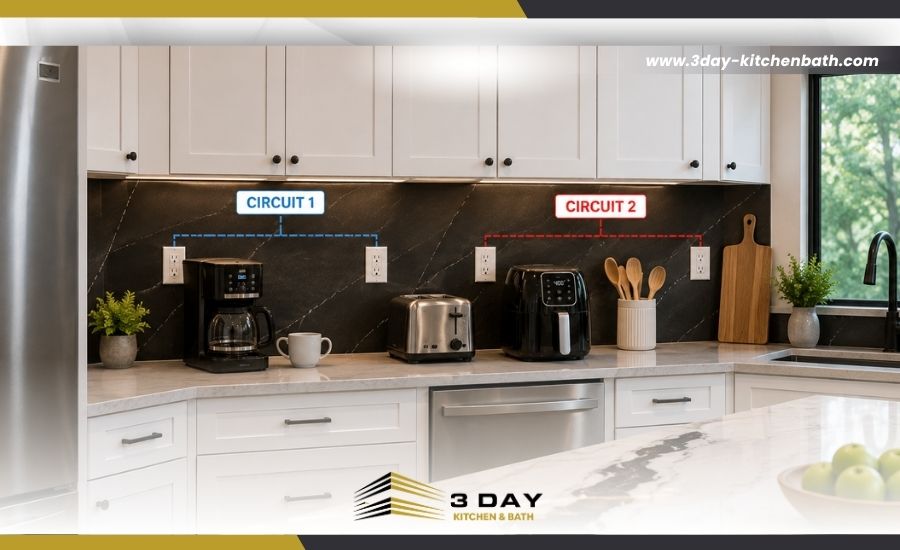
The backbone of kitchen circuit requirements is the small-appliance branch-circuit rule. Code requires a minimum of two 20-amp, 120-volt circuits dedicated solely to countertop and dining area receptacles. These circuits cannot power lighting or large built-in appliances. Their entire job is to serve the plug-in devices homeowners use every day.
- Countertop Coverage: Every countertop section 12 inches wide or wider needs a receptacle within reach, spaced so no point along the counter is more than 24 inches from an outlet.
- Two-Circuit Minimum: The two required small appliance circuits must alternate across the countertop so that no single circuit serves every outlet in the kitchen.
- No Shared Loads: Refrigerators, dishwashers, disposals, and built-in microwaves are not allowed to share these circuits, since doing so defeats the purpose of isolating high-draw appliances.
This is precisely why a coffee maker, a toaster, and an air fryer running together can trip a breaker in an older home. Many kitchens built before current code editions were wired with a single shared circuit for the entire counter, which simply cannot handle the demand load of today’s appliance lineup.
Dedicated Circuits for Major Appliances
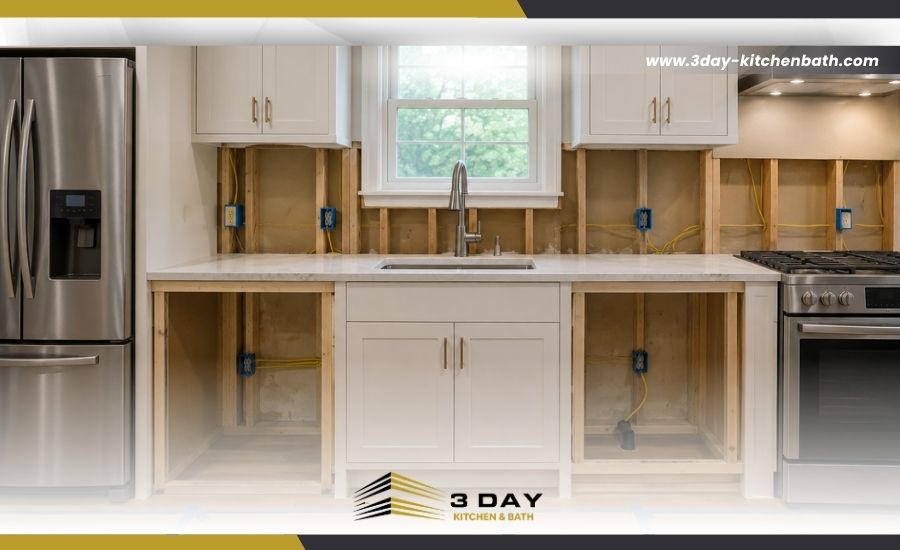
Beyond the small appliance branch circuits, several major kitchen components require their own individual dedicated circuit:
- Refrigerator Circuit: A dedicated 20-amp, 120-volt circuit is standard, keeping the refrigerator’s compressor free from interference by other loads and reducing nuisance trips.
- Dishwasher Circuit: A dedicated 15- or 20-amp, 120-volt circuit is required, and it cannot be shared with the garbage disposal.
- Garbage Disposal Circuit: Its own dedicated circuit, separate from the dishwasher, prevents the two motors from overlapping their startup surge on the same line.
- Built-In Microwave Circuit: A dedicated 20-amp circuit is typical for microwaves that draw significant wattage during their magnetron cycle.
- Range or Cooktop Circuit: Electric ranges and cooktops require a dedicated 240-volt circuit, sized according to the unit’s nameplate rating, often 40 to 50 amps depending on the appliance.
- Lighting Circuit: A separate general lighting circuit powers overhead, recessed, and under-cabinet fixtures, since code does not allow lighting to share a line with the small appliance branch circuits or major appliance circuits.
Understanding Split-Phase 240V Circuits
Large cooking appliances rely on split-phase 240-volt circuits rather than the standard 120-volt circuits used for countertop outlets. A split-phase circuit draws from both energized bus bars in the panel simultaneously, doubling the available voltage to meet the heavy demand of an electric range, oven, or cooktop. This is also why these appliances need their own wire gauge and breaker size calculated from the appliance’s volt-ampere, or VA, demand rating rather than a generic assumption.
Getting this calculation wrong is one of the most common issues found during a kitchen remodel. An undersized breaker on a 240V circuit will trip under normal cooking loads, while an oversized breaker on undersized wire creates a genuine fire risk by allowing current beyond what the wire can safely carry.
GFCI and AFCI Protection
Two forms of protection are now standard throughout kitchen circuits, and homeowners often confuse them:
| GFCI (Ground Fault Circuit Interrupter) | AFCI (Arc Fault Circuit Interrupter) |
| Protects people from shock by shutting off power within milliseconds if it detects current leaking to ground, which is critical near sinks, countertops, and any wet location. | Protects the structure from fire by detecting the electrical signature of a dangerous arc, such as a damaged wire or a loose connection inside a wall. |
Current code editions increasingly call for dual-function AFCI/GFCI breakers on kitchen circuits, combining both protections in a single device at the panel. This is particularly relevant during a remodel, since replacing an old panel or adding new circuits is the natural point to bring the whole kitchen up to this dual-function standard rather than mixing old and new protection types.
Why New Appliances Trip Old Circuits
Homeowners frequently ask why a newly purchased air fryer, espresso machine, or high-wattage blender trips the breaker in a kitchen that was never flagged as a problem before. The answer usually comes down to a handful of factors working together, and each one is worth understanding before assuming the appliance itself is defective:
- Inductive Load Spike: These appliances pull a sharp current spike the moment their heating element or motor engages, even though the appliance’s steady-state wattage looks modest on the label.
- Derated Capacity: An older circuit that is already close to its 80 percent continuous load limit has little headroom left to absorb that spike.
- Shared Circuit Loading: Many older kitchens were wired with a single shared circuit for the entire counter, so one appliance’s spike stacks on top of whatever else is already running.
- Aging Wire Gauge: Wiring installed decades ago may not meet the ampacity today’s higher-wattage appliance lineup needs, even if the breaker itself has since been upgraded.
This is one of the clearest signs that a kitchen’s electrical infrastructure has not kept pace with its appliance lineup, and it is a strong indicator that a remodel should include a full review of circuit distribution, not just a swap of outlet covers.
Planning Circuit Requirements Into Your Remodel

Getting kitchen circuits right takes more than adding an outlet here or there, and it works best when it happens early in any kitchen remodeling project, well before cabinets, countertops, or appliances are selected. Getting this part of the process right up front comes down to a few key steps:
- Load Calculation: Account for every appliance the space will realistically run, including small countertop devices and major built-ins, so the design reflects real-world demand.
- Panel Capacity Review: Confirm the panel has enough spare capacity or amperage to support new dedicated lines without overloading existing circuits.
- Circuit Layout Planning: Spread demand across multiple circuits the way code intends, rather than concentrating load on a single line.
- Protection Placement: Map out where dual-function AFCI/GFCI breakers and dedicated appliance circuits go before construction begins, so the electrical work never becomes an afterthought that limits your design choices later.
Power Your Kitchen Remodel the Right Way
Getting kitchen circuit requirements right the first time protects your home, your appliances, and your remodel budget from costly rework down the line. 3 Day Kitchen & Bath’s experienced licensed electricians and design-build team can map out dedicated circuits, panel capacity, and dual-function breaker placement before a single cabinet goes in, so your finished kitchen runs every appliance safely and without a single tripped breaker.
Power your luxury appliance suite safely and in full compliance with municipal building codes. Schedule a technical structural layout consultation with our master electrical and kitchen remodeling design team today.
Frequently Asked Questions
What are the standard electrical circuit requirements for a kitchen remodel?
A remodel typically needs at least two dedicated 20-amp small appliance circuits for countertops, plus separate dedicated circuits for the refrigerator, dishwasher, garbage disposal, built-in microwave, and a 240-volt circuit for the range or cooktop.
How many dedicated circuits are required in a modern kitchen?
Most modern kitchens need a minimum of six to eight dedicated circuits once countertop, refrigerator, dishwasher, disposal, microwave, and range circuits are all accounted for, though the exact count depends on the appliance lineup and layout.
What is the code for kitchen countertop outlet spacing?
Receptacles must be placed so no point along a countertop is more than 24 inches from an outlet, and any counter section 12 inches wide or wider requires its own accessible receptacle.
Can a dishwasher and garbage disposal share the same circuit?
No. Code requires each appliance to have its own dedicated circuit so their startup current spikes do not overlap and overload a shared line.
Why does my air fryer trip the breaker in a newly remodeled kitchen?
High-wattage countertop appliances like air fryers draw a sharp current spike when their heating element engages, and if that circuit is already near its derated capacity or shared with other devices, the added inductive spike is enough to trip the breaker.

3 Day Kitchen & Bath
10620 Treena St Suite 230,
San Diego, CA 92131
Recent Posts
-

8 Signs It's Time to Remodel Your Kitchen
Sep 08, 2026